Over the past few months, Artificial Intelligence has become the focus of almost every conversation. It sometimes feels as though the challenge is simply to build systems that are faster, smarter, and capable of answering any question.
And yet, working in healthcare every day has taught me that the value of an AI system cannot be measured solely by the quality of its answers.
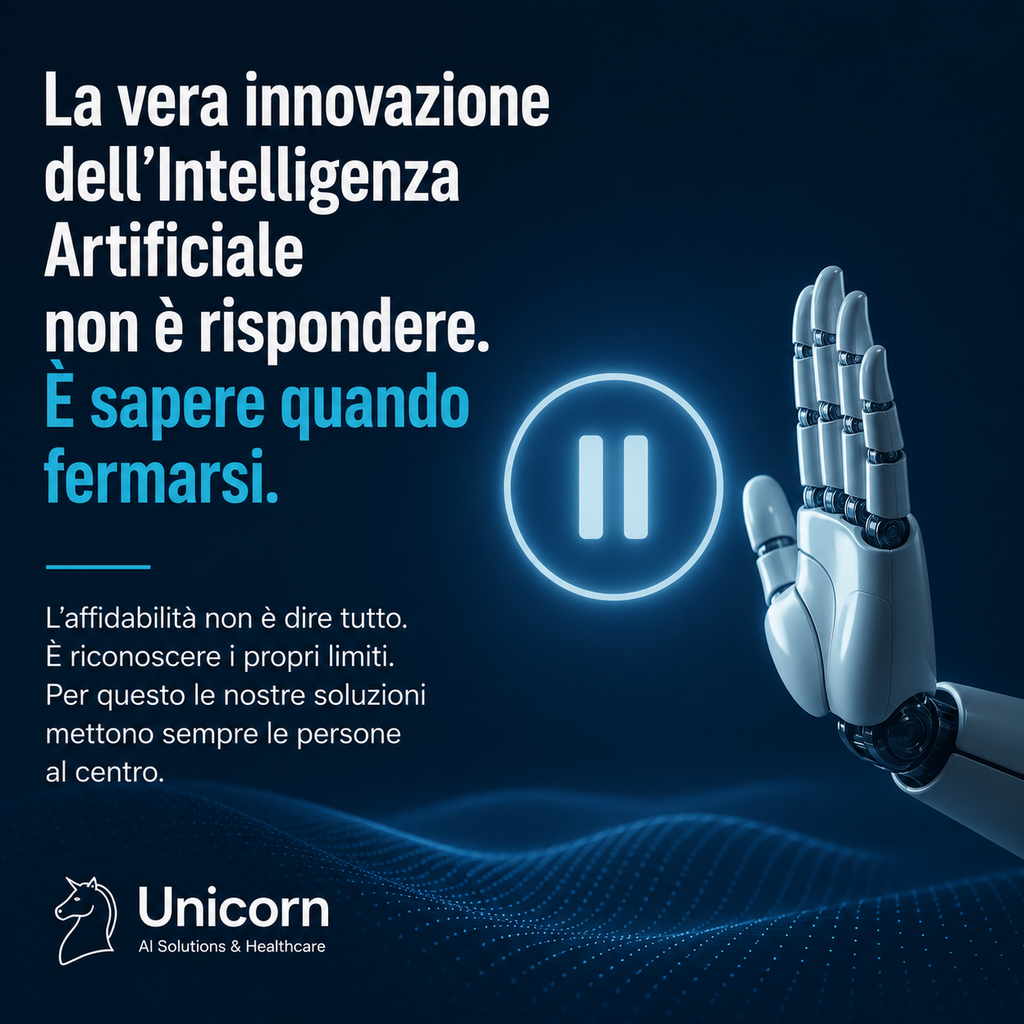
It must also be measured by its ability to recognize its own limitations.
An assistant that invents an answer when it does not have reliable information is not an intelligent assistant. It is a risk.
Trust begins when technology is able to say: “I don’t have enough information to answer.”
It may sound like a step backwards, but it is exactly the opposite.
In medicine, as in many other critical fields, reliability matters far more than creativity. A system must know how to consult the right sources, use up-to-date data, distinguish between what it knows and what it is merely assuming and, above all, always leave the final decision to a human being.
This is the principle guiding the way we design our solutions.
We do not want to build artificial intelligence that replaces professionals.
We want to build tools that help them work better, reducing the time spent on repetitive tasks and increasing the time they can dedicate to people.
Because the real revolution will not be having machines that can speak like human beings.
It will be having systems mature enough to know when to speak… and when it is better to stop.